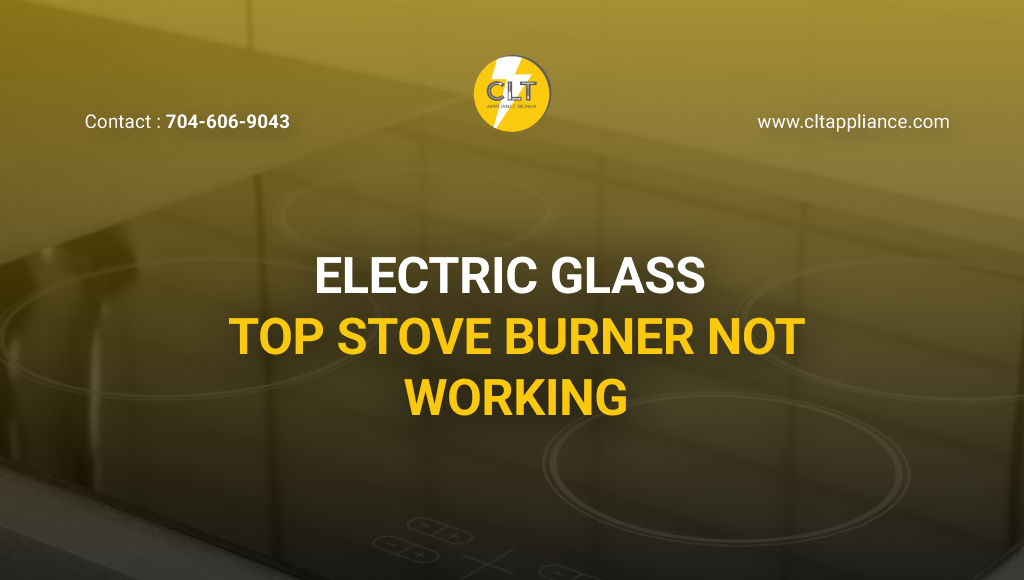
You turn the dial, the indicator light comes on, but the burner stays cold. That single dead burner can stall an entire meal, and the cause is often simpler than it first appears. Electricity is the most common cooking fuel in US homes, with about 74.9 million households cooking on it, which means this problem turns up in kitchens everywhere. Most cases of an electric glass-top stove burner not working in Charlotte, NC trace back to the heating element, its switch, a loose connection, or the power supply. When those basic checks do not solve the problem, Appliance Repair Charlotte, NC can help identify whether the fault is in the burner, controls, wiring, or power supply.
Quick Checks to Do First
Before diagnosing an electric glass-top stove burner not working, rule out the simple causes that stop a burner from heating. These take a minute and solve the problem more often than you would expect.
Run through these quick checks first:
- Confirm you turned the right knob or touch control for that burner
- Check whether the control lock or child lock is switched on
- Look for a residual heat indicator, which means the surface is still cooling
- Make sure nothing spilled onto the control or under the pan
- Reset the circuit breaker for the stove at the electrical panel
If the burner works after one of these, the fix is done. When it stays cold, move on to the causes below.
One Burner or All Burners? What It Tells You
The fastest way to narrow the cause is to notice how many burners are affected. One dead burner points to that burner’s own parts, while several dead burners point to the shared power or controls.
| Symptom | Where the Fault Usually Lies |
| One burner will not heat | That element, its switch, or its wiring connection |
| All burners are dead | Power supply, tripped breaker, or the main control board |
| A burner heats slowly or unevenly | A weak element, a damaged surface, or a failing switch |
Use this as your starting point. The sections below explain each cause and how to address it.
Quick Test:
If only one burner is out, move a working element of the same size into its spot. When that burner heats, the element is the problem. When it stays cold, the fault is in the switch, wiring, or receptacle.
Common Causes of a Glass Top Burner Not Working
Once you know whether one or all burners are affected, you can pin down the specific fault. The following are the causes behind an electric glass-top stove burner not working, from the most common to the least common.
Burned-Out Heating Element
The radiant element under the glass is the part that actually produces heat, and it wears out over years of heating and cooling. A failed one leaves that burner cold while the others keep working.
The swap test above is the quickest way to confirm the element is the cause. If a known-good element heats in that spot, the original element was the problem.
Faulty Infinite Switch
Each burner has an infinite switch that controls how much power reaches the element. When this switch fails, the burner behaves in one of a few telling ways:
- No heat at all, even on the highest setting
- Cycling on and off on its own
- Stuck on full heat regardless of the dial
The switch is a common suspect when the element tests fine, and only one burner is affected.
Loose or Burned Element Connection
The element plugs into a receptacle, and that connection carries heavy current to produce heat. Over time, the terminals can loosen, corrode, or burn, which cuts the power reaching the element.
Charred or discolored terminals are a clear sign of a failing connection. The receptacle needs replacing before a new element will work safely.
Engaged Control Lock
Many glass-top stoves include a control lock that disables the burners, often to keep children from turning them on. When the lock is active, the burners will not respond even though the stove has power.
Clearing it is simple on most models. Holding the lock button for a few seconds usually resets it, and the manual lists the exact step for your stove.
Tripped Breaker or Power Supply Fault
When every burner is dead, the problem is usually upstream of the cooktop. Common culprits include a tripped breaker, a blown fuse, or a loose wire at the power connection, any of which can cut power to the whole stove.
Older homes see this most often. The average American home was built in 1977, and many of those circuits were not built for the electrical load of a modern range. Resetting the breaker is safe to try, but repeated tripping points to a wiring fault that needs a professional.
Failed Surface Element Board
Stoves with touch controls rely on a surface element board to switch power to each burner. When this board fails, the symptoms tend to show up in a few ways:
- One or more burners stop heating entirely
- The touch controls respond slowly or incorrectly
- Some burners work while others on the same board stay dead
Board testing and replacement call for a technician, since the work involves the stove’s high-voltage wiring.
Cracked or Damaged Glass Surface
Cracks or significant damage to the glass can compromise the cooktop’s safety and expose the components underneath to moisture or further damage. If the damage is directly over a heating element, the burner may also heat unevenly or fail to work properly.
A cracked cooktop should not be used until it has been inspected. Turn off the cooktop at the breaker and have the glass surface assessed by a qualified technician. Depending on the extent of the damage and the model, the glass may need to be replaced before the cooktop can be safely used again.
How to Fix a Glass Top Burner That Won’t Heat
Some of these faults are safe to check yourself, while others belong to a technician. Start with the safe steps below, and stop at the point where live wiring or the control board is involved.
Work through the safe checks in this order:
- Cut power to the stove at the breaker before touching any part of the cooktop
- Clear the control lock, then confirm the correct burner and heat setting
- Reset the breaker once, and check for a blown fuse if the stove stays dead
- Swap the suspect element with a working one of the same size to test it
The first three checks are generally safe for a homeowner to perform. Element testing or replacement depends on the stove’s design and should be left to a qualified technician if it requires opening the cooktop or accessing internal connections.
Safety Steps Before You Start
Electric cooktops run on a 240-volt circuit, which carries enough current to cause serious injury. Simple precautions keep any check you make safe.
Faulty electrical connections are also a fire hazard. Home electrical fires cause an estimated 51,000 fires and nearly 500 deaths each year, which means any burned wiring or scorched receptacle is best handled by a professional. When a connection looks damaged, stop and call a technician.
Switch off the stove’s breaker at the panel before you remove a knob, lift the glass, or touch any internal part. Confirm the surface is cool, and never test wiring while the circuit is live.
When to Call a Professional
Some repairs on a glass-top stove are straightforward, while others involve live wiring and specialized parts. Once the fault runs deeper than the safe checks above, a trained technician is the safer choice.
When an electric cooktop needs appliance repair in Charlotte, NC, a technician can test the faulty component before replacing any parts. CLT Appliance Repair handles these repairs across Charlotte, NC, with skilled technicians who work on every major brand.
Most repairs are completed in a single visit, which gets your cooktop back in service quickly!
FAQs
Why is only one burner on a glass-top stove not working?
A single dead burner usually points to a failed heating element, a faulty infinite switch, or a burned connection at that burner. Swapping in a working element of the same size quickly shows whether the element itself is the cause.
Can a glass-top stove heating element be replaced at home?
Testing an element by swapping it is safe, but replacing one means opening the cooktop and handling a 240-volt connection. Most homeowners are better off having a technician complete the replacement and confirm the receptacle is sound.
Why are all the burners on an electric glass-top stove not heating?
When every burner is dead, the cause is usually the power supply rather than the burners. Check for a tripped breaker or a blown fuse first, then have the wiring or control board inspected if the power reads normal.
Conclusion
Most cases of an electric glass-top stove burner not working come down to a handful of causes. Start by noting whether one burner or all of them are affected, run the quick checks, and use the element swap to test a single dead burner. Simple faults like a control lock or a tripped breaker are safe to handle yourself, while wiring, switches, and the control board are best left to a professional.
When the safe checks come up empty, the fault is inside the cooktop’s wiring, and that is the point to bring in help. CLT Appliance Repair covers Charlotte, NC, and the nearby area every day of the week, and our EPA-certified technicians work on gas, electric, and induction cooktops from every major brand. We find the exact part behind the dead burner, fix only what needs fixing, and stand behind the repair.
Reach out whenever your cooktop needs a closer look, and get back to a fully working stovetop.
Author

- John Bennett is a seasoned appliance repair specialist at CLT Appliance Repair, where he brings over a decade of technical expertise and a strong commitment to customer satisfaction. With a background in electrical and mechanical systems, John has built a reputation for reliable, efficient, and honest repair services across a wide range of household appliances-including refrigerators, washing machines, ovens, and more.