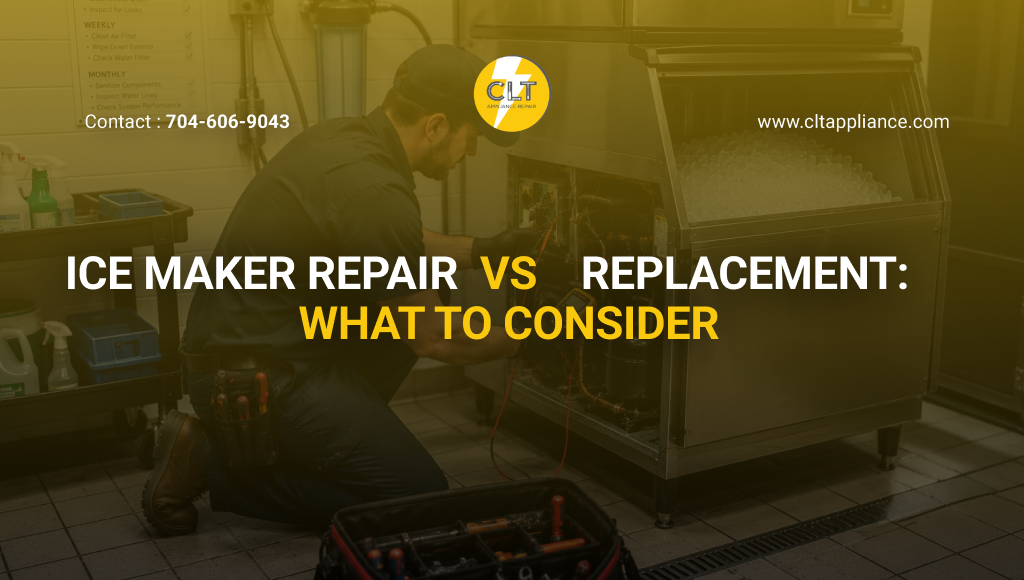
An ice maker rarely breaks all at once. It usually starts with smaller cubes, a slower fill, or a strange taste, and many people ignore those early hints until the bin sits empty for good. Catching the warning signs early gives you the best chance to handle a simple ice maker repair before the problem spreads to other parts of your refrigerator.
Ice makers also fail more often than most homeowners realize. About 31% of refrigerators with ice makers develop a problem by the end of the fifth year, and ice makers and water dispensers are the two most commonly reported refrigerator issues. But the warning signs are easy to recognize once you know what to look for, and many of them have simple fixes.
Common Signs Your Ice Maker Needs Repair
Your ice maker usually gives clear warnings before it quits completely. Watch for any of these signs, since spotting them early often means a simpler and cheaper repair.
No Ice, or a Sudden Drop in Production
The most obvious sign is an empty bin when the unit should be full. A complete stop often points to a water supply problem, a clogged filter, or a failed component inside the ice maker. A sudden drop in how much ice you get usually signals the same causes at an early stage, so it is worth acting before production stops entirely.
Small, Hollow, or Misshapen Cubes
When cubes come out tiny, partly formed, or hollow, your ice maker is not getting enough water. This usually traces back to low water pressure, a clogged filter, or a partially blocked supply line. The ice may still work in a pinch, but the shrinking size is an early clue that something is restricting the water flow.
Cloudy, Bad-Tasting, or Smelly Ice
Ice should be clear and neutral in taste. Cloudy cubes, an odd flavor, or a musty smell often come from an old water filter, mineral buildup, or food odors absorbed inside the freezer. Replacing the filter and cleaning the bin usually helps, but lingering taste can indicate buildup deeper in the water line.
Ice That Will Not Release, or Clumps and Jams
If cubes stick in the mold or freeze together into a solid block, the ejector, heating element, or temperature settings may be at fault. Clumping also happens when ice melts slightly and refreezes, which often means the freezer is not holding a steady temperature. A unit that constantly jams needs a closer look before it strains the motor.
Leaks or Water Pooling Around the Fridge
Water on the floor or inside the freezer is more than a nuisance. It usually means a cracked water line, a loose connection, a faulty inlet valve, or a unit that is out of level. Leaks can damage your flooring and cabinets over time, so this is one sign you should not put off.
Unusual Noises or a Unit That Never Stops Cycling
Grinding, buzzing, or loud humming can signal a worn motor or a struggling valve. An ice maker that runs constantly without producing much ice is working harder than it should, which wastes energy and shortens its life. Both point to a part that is wearing out and due for service.
What’s Causing Your Ice Maker to Fail?
Most ice maker issues trace back to a short list of common causes, and water quality is often near the top. Hard water is common across much of the United States, and the mineral scale it leaves behind can clog water lines and filters and reduce how efficiently appliances run.
With that in mind, here are the reasons behind most ice maker problems:
- A clogged or expired water filter restricting flow
- Low water pressure or a kinked, blocked supply line
- A faulty water inlet valve that controls water entering the unit
- A frozen fill tube that blocks water from reaching the mold
- A broken control arm or sensor telling the unit to stop
- A warm freezer or dirty condenser coils affecting freezing
- A worn-out ice maker assembly near the end of its life
Most of these problems start small and quietly grow worse the longer they are left alone. Pinpointing the cause early is what separates a quick part swap from a full ice maker replacement.
What to Do Next: Quick Fixes to Try First
Before you call anyone, a few simple checks resolve a surprising number of ice maker problems. None of these requires tools or technical skill, and they are safe for any homeowner to try.
- Confirm the ice maker is switched on and not in a paused or off mode
- Check that the water shut-off valve behind the fridge is fully open
- Replace the water filter if it is more than six months old
- Reset the ice maker with the power switch or reset button, then wait 24 hours
- Set the freezer to around 0°F so ice can form properly
- Look for a frozen fill tube and thaw it gently if you find one
- Level the refrigerator so the unit sits evenly
If the ice maker still struggles after these steps, the problem usually lies deeper in the system, such as a faulty inlet valve, a failed control board, or a sealed-system fault that calls for a trained technician. At CLT Appliance Repair, our EPA-certified technicians handle ice maker repair and other refrigerator problems across Charlotte and the surrounding areas, often with same-day service and most fixes completed on the first visit.
If your ice maker needs more than a quick fix, call us at 704-606-9043 to book a convenient time.
Important FAQs
Why is my ice maker not working after I reset it?
A reset only fixes minor glitches. If nothing changes, the cause is usually mechanical, such as a clogged filter, a closed water valve, a frozen fill tube, or a failed inlet valve that needs professional attention.
How often should I change my refrigerator water filter?
Most manufacturers recommend replacing the water filter every six months. If you have hard water or use a lot of ice and water, you may need to change it more often to keep the flow and taste consistent.
Why does my ice taste or smell bad?
Bad-tasting ice usually comes from an old water filter, mineral buildup in the water line, or food odors absorbed inside the freezer. Replacing the filter and cleaning the bin solves it, but lingering issues need a closer look.
Takeaway
A failing ice maker is easy to overlook, but the warning signs are usually clear once you know what to watch for. Smaller cubes, cloudy ice, leaks, and odd noises all point to problems that are simpler and cheaper to fix early. Start with the basic checks, keep up with routine maintenance, and call a professional when the issue runs deeper than a filter or a reset. A quick response keeps your ice maker working and protects the rest of your refrigerator.
Need Your Ice Maker Fixed Fast?
We make ice maker repair simple, fast, and stress-free for homeowners across Charlotte and the surrounding areas. Our certified technicians at CLT Appliance Repair arrive prepared, diagnose the issue quickly, and finish most repairs on the first visit, all backed by a six-month warranty.
Call us at 704-606-9043 or book online now, claim your $15 off your first repair, and get your ice maker working like new again.
Author

- John Bennett is a seasoned appliance repair specialist at CLT Appliance Repair, where he brings over a decade of technical expertise and a strong commitment to customer satisfaction. With a background in electrical and mechanical systems, John has built a reputation for reliable, efficient, and honest repair services across a wide range of household appliances-including refrigerators, washing machines, ovens, and more.